Job Market Cooldown: U.S. Job Openings Hit a 2.5-Year Low in July
Posted on August 30, 2023 | by The Economic Pulse
If you’ve been feeling a shift in the air of the U.S. job market, you’re not imagining things. The latest data from the Bureau of Labor Statistics confirms it: the red-hot job market is finally, and clearly, cooling off.
The number of job openings in the U.S. fell to 8.8 million in July, a significant drop from the previous month and the lowest level since March 2021. This marks a stark contrast from the record-breaking 12 million openings we saw just a year ago.
So, what’s behind this slowdown, and what does it mean for employers, job seekers, and the broader economy? Let’s break it down.
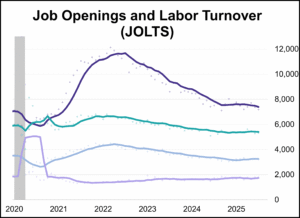
Source: U.S. Bureau of Labor Statistics | Chart: The Economic Pulse
The Big Picture: A Market Rebalancing Act
For the past two years, the narrative has been all about the “Great Resignation” and the worker’s market. Employers were scrambling to fill roles, offering signing bonuses and higher wages to attract scarce talent. The power sat squarely with employees.
The July JOLTS report suggests we are moving into a phase of rebalancing. The economy is slowly shifting from a wild, uncontrolled burn to a more sustainable simmer. This is not necessarily a bad thing; in fact, it’s exactly what the Federal Reserve has been trying to achieve with its interest rate hikes.
Why Are Job Openings Falling? 3 Key Reasons
1. The Fed’s Aggressive Interest Rate Hikes
This is the biggest driver. The Federal Reserve has been raising interest rates at the fastest pace in decades to combat stubborn inflation. The goal is to cool down the entire economy by making borrowing more expensive for everyone—from consumers taking out mortgages to businesses looking to expand.
The Federal Reserve’s policy decisions have a direct impact on hiring plans across the country.
When it costs more for a company to borrow money to open a new factory, launch a new product line, or expand its team, they pull back. This naturally leads to a reduction in new job postings and a more cautious approach to hiring. Sectors like technology, real estate, and manufacturing, which are particularly sensitive to interest rates, have seen some of the most notable pullbacks.
2. Employer Caution and Economic Uncertainty
While we’re likely avoiding a major recession, talk of an economic slowdown has been persistent. Businesses are hearing this and becoming more cautious about their future prospects. Instead of hiring aggressively for future growth, many are opting to pause hiring, freeze hiring, or only replace essential roles that become vacant. This “wait-and-see” approach directly reduces the number of openings on the market.
3. A Normalization from Extreme Highs
It’s important to remember the context. The 12 million job openings we saw in 2022 were a historical anomaly, fueled by massive post-pandemic demand and a unique set of economic circumstances. A drop to 8.8 million is a move down from an extremely high peak, bringing us closer to pre-pandemic levels (which were still considered healthy). The market isn’t collapsing; it’s returning to a more normal state.
What This Means for You
· For Employers: The intense competition for talent may be easing slightly. You might find a larger pool of qualified applicants for open positions, and wage growth pressures could continue to moderate. However, unemployment remains low, meaning skilled workers are still in demand—it’s just not the free-for-all it was 18 months ago.
· For Job Seekers: The environment is becoming more competitive. The days of having multiple offers with significant signing bonuses might be waning for some roles. It’s more important than ever to tailor your application materials, highlight specific skills, and be prepared for a longer search process. Don’t be discouraged; there are still nearly 1.5 jobs for every unemployed person, which indicates a strong market, just not a record-breaking one.
· For the Economy: This is a key data point the Fed will be watching closely. A gradual cooling in the labor market helps ease upward pressure on wages, which is a key component of inflation. If this trend continues modestly, it could allow the Fed to pause its rate hikes sooner, potentially engineering the coveted “soft landing” for the economy.

The job market is becoming more balanced, requiring both employers and job seekers to adapt their strategies.
The Bottom Line
The drop in job openings is a sign of a maturing economic cycle, not a cause for panic. The market is normalizing after a period of historic turbulence. While the winds are shifting, they are blowing toward a more sustainable and balanced economy for the long haul.
Stay tuned for next month’s JOLTS report to see if this trend continues!
What’s your experience been like in the current job market? Have you noticed a shift? Share your thoughts in the comments below!
—
Disclaimer: This blog post is for informational purposes only and does not constitute financial advice.
 |
|