Sep 28, 2025 .
Your Home Sweet (Home Office): A Smart Guide to Tax Write-Offs
Let’s be honest, tax season can feel daunting. But what if we told you that the place you curl up with a good book and binge-watch your favorite shows could also be a powerful tool for saving money at tax time?
If you use part of your home regularly and exclusively for business, you might be eligible for the Home Office Deduction. It’s one of the most valuable—and misunderstood—tax breaks for entrepreneurs, freelancers, and small business owners.
Before you get too excited and start deducting your mortgage, let’s walk through the rules, the methods, and the common pitfalls.
—
First, The Golden Rule: Do You Qualify?
The IRS has two main tests you must pass. This isn’t a “well, I check emails from my couch sometimes” situation. The rules are strict.
1. Regular and Exclusive Use: You must use a specific area of your home only for your trade or business. This could be a spare room, a partitioned-off section of a room, or even a separate structure (like a studio or garage). If your “office” is the kitchen table that also serves as the family dinner spot, it won’t qualify.
2. Principal Place of Business: Your home office must be your main place of business. This means:
· You use it exclusively and regularly for administrative or management activities (like invoicing, scheduling, and record-keeping), AND
· You have no other fixed location where you conduct substantial administrative work.
💡 Pro Tip: Freelancers and remote employees, take note! The “exclusive use” rule is key. If you’re a W-2 employee working remotely, your home office must be for the convenience of your employer to qualify, and the deduction is currently suspended for employees under the TCJA (though this doesn’t affect self-employed individuals).
—
The Two Ways to Calculate Your Deduction
Once you’ve confirmed you qualify, you have a choice to make. You can pick the method that gives you the bigger deduction.
Method 1: The Simplified Option (The Easy Button)
This method is, as the name implies, straightforward. No complicated math, no keeping every utility receipt.
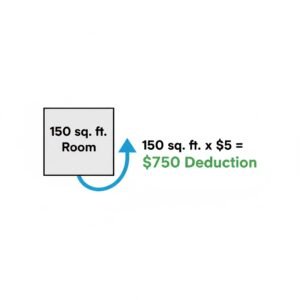
· How it works: You deduct $5 per square foot of the space used for business, up to a maximum of 300 square feet.
· Maximum Deduction: $1,500 (300 sq. ft. x $5).
· Pros: Incredibly easy, less record-keeping.
· Cons: You might get a smaller deduction than with the regular method, especially if you have high home expenses.
Method 2: The Regular Method (The Detailed Approach)
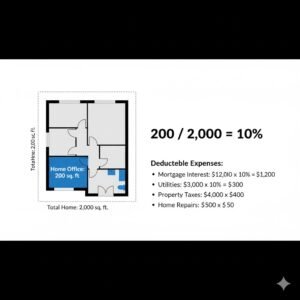
This is the classic way to calculate the deduction. It involves measuring your home office space and determining what percentage of your home it occupies. Then, you apply that percentage to your total home expenses.
· How it works:
1. Calculate the percentage of your home used for business. (Square footage of office ÷ Total square footage of home).
2. Apply that percentage to your eligible home expenses.
What Expenses Can You Deduct with the Regular Method?
· Direct Expenses: Costs only for your home office. (e.g., painting the office, repairing a window in the office).
· Indirect Expenses: Costs for keeping your entire home running, which you can deduct a percentage of.
· Mortgage Interest or Rent
· Property Taxes
· Insurance
· Utilities (electricity, gas, water, internet*)
· Repairs & Maintenance (e.g., HVAC servicing, roof repair)
· Security System
· Depreciation (the loss in value of your home over time)
*Internet Note: You can deduct the business percentage of your internet bill. If you use it 50% for business and 50% for personal, you should only deduct the business portion, even if your office percentage is higher.
· Pros: Can result in a much larger deduction.
· Cons: Requires meticulous record-keeping and is more complex.
—
What You CANNOT Deduct (The “Don’t Even Think About It” List)
It’s crucial to know the boundaries to avoid an audit.
· The coffee maker in your kitchen. (Unless your kitchen is your exclusive office, which it isn’t.)
· Your entire mortgage payment. (You can only deduct the interest and taxes portion via the methods above.)
· Landscaping or lawn care. (Unless you meet clients at your home and the landscaping is a direct business expense, which is a very high bar.)
· Domestic help. (Sorry, you can’t write off the house cleaner, even if they clean your office too.)
—
Actionable Steps & Best Practices
1. Take a Picture! Document your dedicated office space. This is your best defense in case of an audit.

2. Keep Impeccable Records. Save all your bills for mortgage interest, utilities, insurance, and repairs. A simple folder (digital or physical) will do.
3. Consult a Professional. When in doubt, talk to a qualified tax advisor or CPA. The cost of their service is also a tax deduction! They can provide personalized advice for your specific situation.
—
The Bottom Line
Using your home as a tax write-off can be a legitimate and significant financial benefit for your business. By understanding the rules, choosing the right calculation method, and keeping solid records, you can confidently turn your home sweet home into a smarter financial asset.
Check this video out explaining in more detail!
Disclaimer: I am a blogger, not a CPA or tax attorney. This information is for educational purposes only. Tax laws are complex and change frequently. Please consult with a qualified tax professional about your specific circumstances.

—